
Recovery from Back Surgery: My Spinal Surgery Story
When you learn you have to have spine surgery, the first question is often “What is the recovery from back surgery like?” When my surgeon told me I needed to have a laminectomy, decompression, and a possible spinal fusion at L4-L5, a lot of questions went through my mind. The first was how long is the recovery time and what is the healing process like. (The second was about risks and what happens if I don’t do it…I’m no dummy, I didn’t go into it blind, but major surgery is disruptive for you and your family, so it’s a very fair first concern.) I’m five months out from my surgery, and here’s my story.
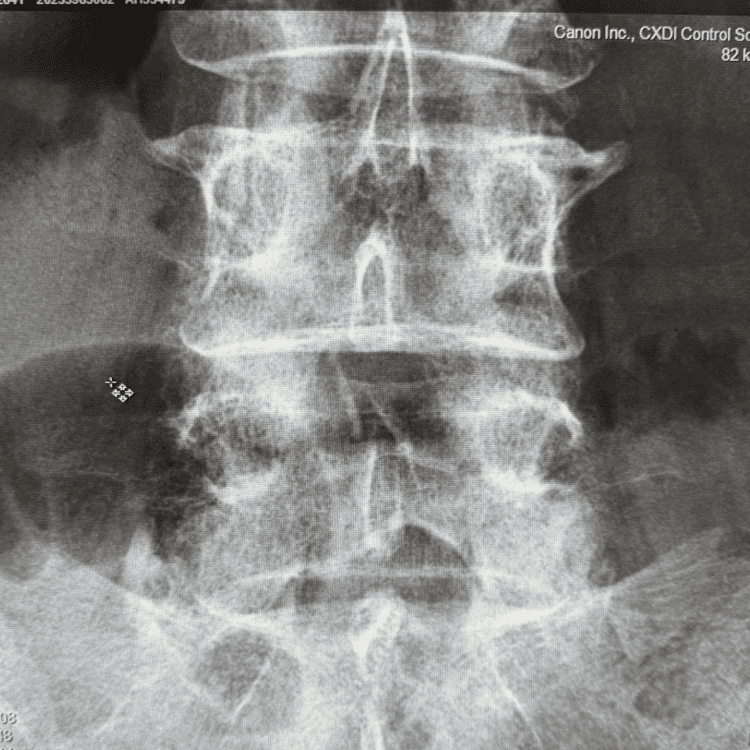
I’ve shared my diagnosis and how my back injury occurred in another post a few months ago, so I won’t repeat it all here. (In that post, you’ll find a long but inclusive list of items you’ll need to have available after surgery, and how you can be prepared at home. It’s a great reference if you or someone close has scheduled their back surgery.)
In short, I had a diagnosis of severe spinal stenosis, herniated discs, a cyst crowding my spinal column, and just general bad wear and tear with a large side of osteoarthritis throughout my entire back. My spinal surgeon had me prepped for a laminectomy, decompression, cyst removal and likely, a fusion. Thankfully, once in there, he learned my spine was still stable enough to avoid the fusion. )If you have a fusion, you’ll have a longer recovery than a laminectomy, and you’ll have more, longer restrictions, so keep that in mind when reading!)
Also, I am not a doctor, just a patient sharing her story.
My Back Surgery Recovery Story
I got lucky and was only hospitalized overnight as an outpatient at an amazing hospital here in southern California, Huntington Memorial. It’s a beautiful place on a hill in Arcadia, a Cedars-Sinai hospital, and renowned for patient care and top notch doctors. My experience with them was nothing but positive — I mean, 24/7 room service with a massive menu is a big deal on its own, but the medical staff there was stellar, compassionate, caring, and when I pushed a button for a nurse, I never waited more than a minute, and that’s if I had to push it at all. They were constantly checking in on me, and my private room had everything I needed. My recovery process began there, but I was soon at home, in my bed, and ready for the real work to start.
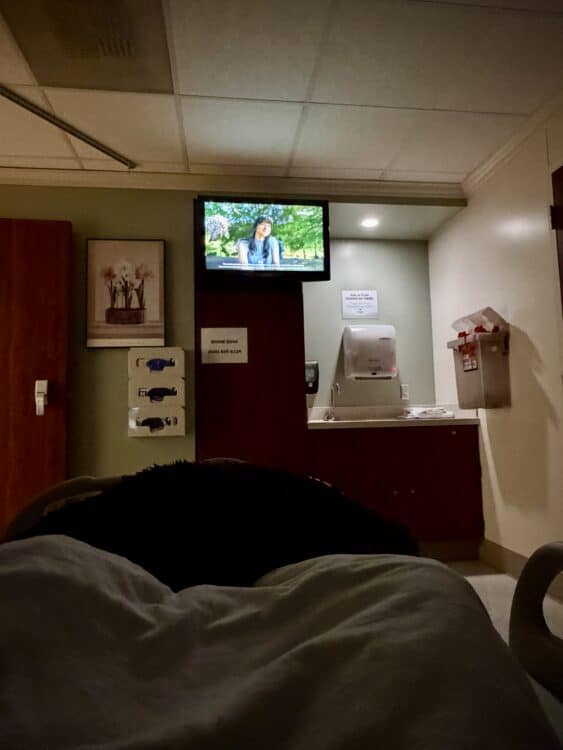
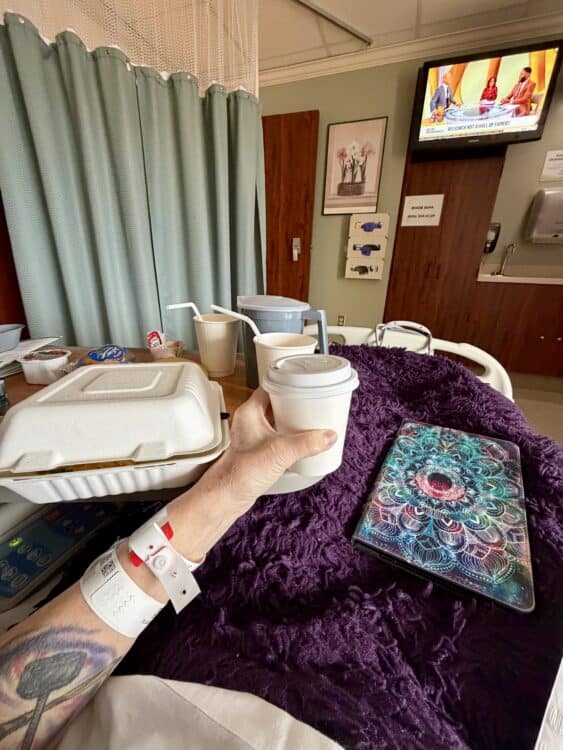
Back surgery recovery is going to be heavily based on your existing health, the severity/type of your surgery, and if you follow directions. My experience won’t be yours, but the basics are the same.
Immediate Recovery Process after a Laminectomy and Spinal Decompression
The first few days at home, I was on heavy pain meds and other than potty trips and a few short walks back and forth in my bedroom, with my walker, I was in bed. As the days went by, I added length to the walks, going to the balcony, sitting outside to get some fresh air. I wore my back brace consistently every time I was out of the bed, and when I was in the bed, I used a wedge pillow and body pillows to prevent me from rolling over. ANY rolling has to be done in one unit, called the “log roll.” My bedrail helped the bracing, and when I had to get up, it helped me pull myself into the seated position.
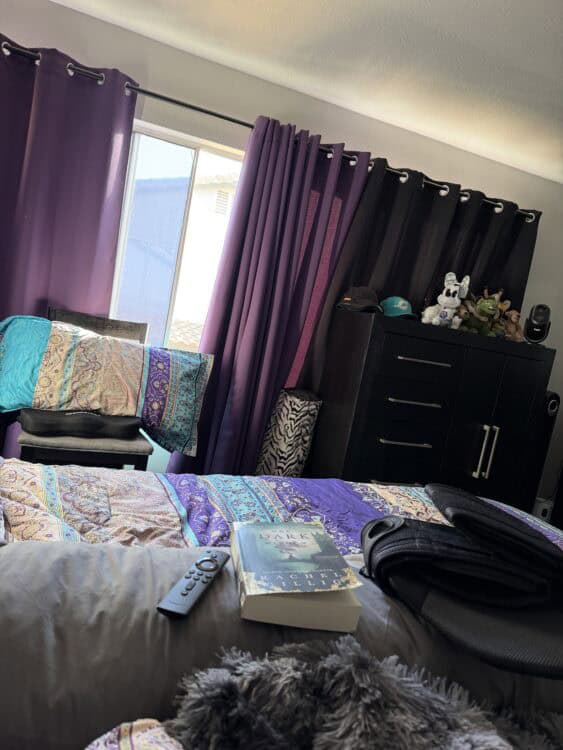
Let’s talk a little more about that first day at home. My doctor loaded me up on pain meds, and anti-nausea meds, right before we got into the car for the 1-2 hour drive home. The hubs drove slow enough to handle potholes and bumps but fast enough to not prolong it. (He had actually been paying attention to the road on prior visits so he could be prepared.) I’d decided I wanted to stay upstairs instead of down, where I’d have more privacy and my sleep habits wouldn’t interfere with everyone else’s regular daily activity. That meant I had to get up the stairs..but first, I had to get out of the car and up our very sloped driveway with my walker. Hubs helped, son came out to help guide and open/close doors. (Even opening a car door was a lot for me those first couple of weeks. Stretching is painful and something to be avoided until cleared.)
I stayed on top of the nausea meds, so I didn’t vomit at all once home (don’t ask me about the hours after surgery though) but I was dizzy on/off. After one of my potty visits that first day, I had the worst case of restless leg syndrome I’ve ever had. My legs were so violently jumping, the hubs had to lay across them. I was miserable. I had to walk gently, but also, don’t put off using the restroom when you need to or it has a way of suddenly being urgent and you take a while to get up.
I slept on and off that first evening, making it through the night with the help of a pain pill. My big body pillow kept me from rolling over, and if I needed something, the hubs was there but unable to erroneously bump into me.
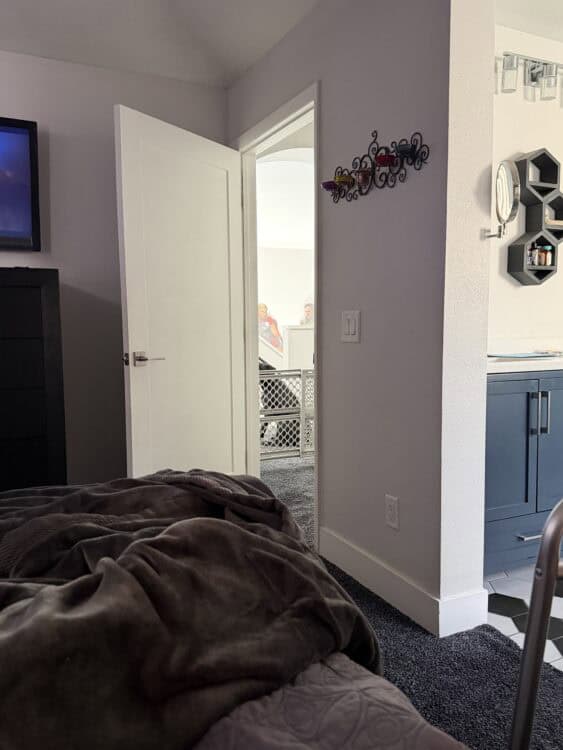
As far as eating, my appetite returned fairly quickly, and I could eat normal foods. My family brought me meals, and I’d sit up — following my doctor’s directions — to eat. Otherwise, I found that laying back, almost flat, was the most comfortable. Eventually, I segued to more of the wedge with pillows so I could read without having to hold the book or my tablet up. I could see the tv, and I had everything I needed within reach without twisting. No BLT will become your life in regards to moving: no bending, lifting, or twisting.
That includes in every movement….e v e r y t h i n g. You will need help using the restroom by way of a bidet or a tool that holds toilet paper for you, when your insides finally start working again. (Take the meds they recommend right when they say to start; you do not want to wait until it becomes a problem.) I was never so thankful for a toilet riser and personal bidet (they make squirt bottles too, with a weird bendy nozzle, so you don’t have to spend big bucks) as I was those first few weeks. Dignity what? I dreaded needing help, and those tools meant I could independently use the restroom.
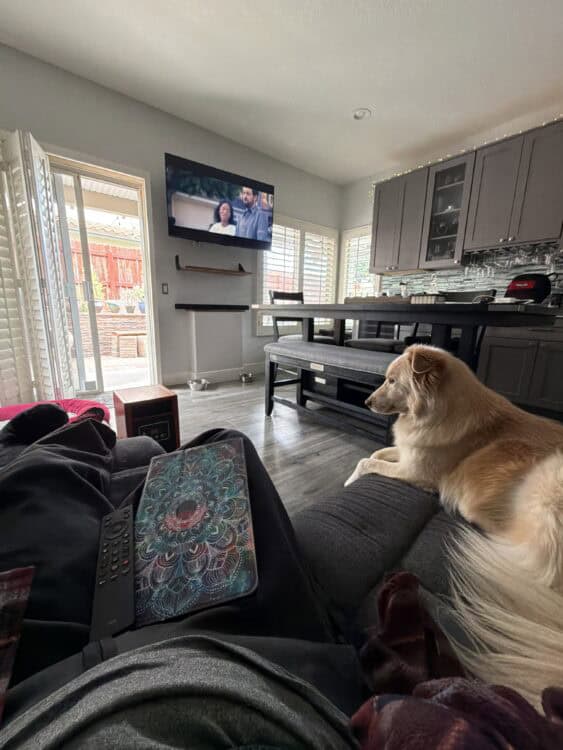
And yes, weeks. You’ll need your doctor’s okay to start more normal activity. Keep that grabber handy. After two weeks, I went downstairs; it wasn’t hard, but the jarring movement of stepping down meant that when I got down there, I stayed there for hours. A recliner is very handy, but some people find a couch suffices. I sat in a mix of both, but mainly the recliner, permanently reclined; using the up/down handle was too difficult that first week, and pushing it down took weeks longer.
What to Expect Weeks 1-2 after Spinal Surgery
I showered for the first time two days after I got home. I just couldn’t that first day. Showering was hard. We had a shower stool and my husband would basically do it all for me those first few days. My stability was off and my balance was not to be trusted. I also couldn’t stretch to reach my feet or turn to wash my back. He would remove the bandages daily and replace them with fresh ones after my shower. It was a process daily, let me tell you. I looked forward to it after the first 10-12 days, but it was weeks before I stopped using the shower stool. Showers take way more energy than you think. I’d get back into jammies that first 7-10 days, and then I started putting on ‘real’ clothes.
For clothes, I had purchased front-fastening bras but ended up not needing them. I lived in sports bras or gentle bralettes, so nothing required twisting. Otherwise, I wore baggy sweats without tight elastic and baggy shirts. I could dress myself after that first 4-5 days; if forced, I could have done it sooner, but I didn’t have the need. Depending on where your surgery was, your clothing may need to be different; you don’t want a waistband digging into your stitches. They will be painful enough as it is.
After two weeks, I returned to work, but disclaimer: I work at home running a social media agency. I worked on a fatty cushion for very short periods of time at the table, then I’d rotate to the recliner for another period of time. Movement was my friend. I’d set timers to make sure I wasn’t static for more than 20-30 minutes at a time. Getting stiff was more painful than getting up and moving around. I worked shortened and very random hours and didn’t do anything on camera.
What kind of pain did I feel during recovery?
Not much those first few days. I stayed on top of the meds religiously, but on day four, I stopped the narcotics and switched to tylenol. It wasn’t perfect, but I hated the grogginess and having to take anti-nausea meds. I was incredibly sore, especially on my lower right. For weeks, that remained, though it regularly improved. Thank God for the walker.
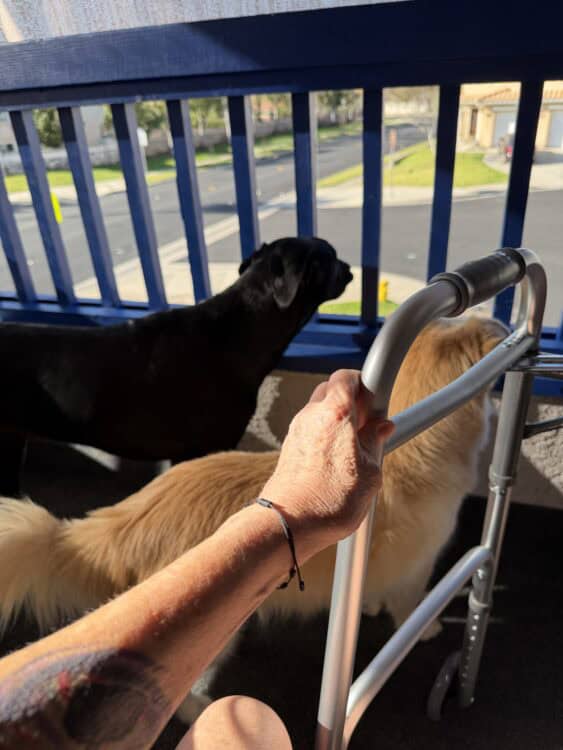
Even 2-3 months later, I felt what I could only describe as a fiber tearing/pulling. When the doctor’s in there removing bone, he’s moving things aside, and after surgery, those things attempt to go back in place, along with the nerves and other things that weren’t where they should be. Scar tissue, muscle pulling, nerves learning to work again, it’s not a pain-free process.
Weeks 3 to 6 after Back Surgery Recovery Timeline
I didn’t ride in the car for about six weeks other than my doctor’s appointments. My doctor cleared me to drive after four weeks, as long as I could drive safely and was not on narcotics. (I could, and I wasn’t.) Driving required me avoiding potholes and swift braking. My back would begin to hurt just while sitting up straight, so adjust your seat carefully, and if someone else can drive, cool.
Physical therapy began about six weeks after surgery. Some people do start sooner, but my therapist of choice was away for about a week and due to their schedule, I was pushed out about 10-12 days longer than I would have. PT hurt, not gonna lie, but the therapists were very careful to not push me into anything at all; if it hurt above a two on the pain scale, I was to stop. That was pretty much all of it at first, so things were dialed back and a manageable PT regimen that helped in recovery without any regression was developed.
PT isn’t just in the office. It’s at home, too. Daily. At five months post-op, I’m still getting therapy twice a week. There are phases, so once you get to a certain point, they increase difficulty, but again, no pain above a two. I spoke up when it hurt or cracked or anything weird, so it could be modified.
Communication with your doctors and therapists is critical.
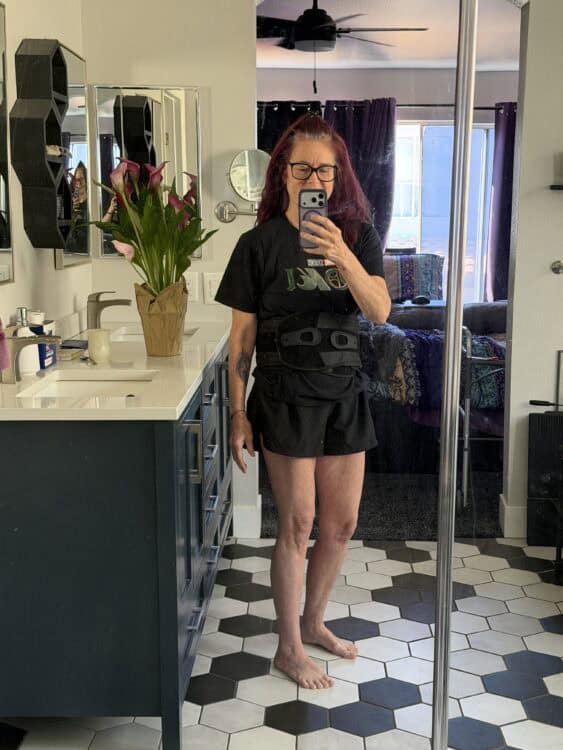
When I finally left the house for something other than PT, it was about six weeks post-op. (I was SO excited, I took a pic of me standing up, something I did along the way, smiling big in my brace.) The venue provided a cushioned chair for me, and I sat on the end, where I could easily stand up and move without getting in others’ way. I wore my brace for around 8-10 weeks, but I began to go without it in short spurts after 8 weeks or so. Some days I wore it longer than others.
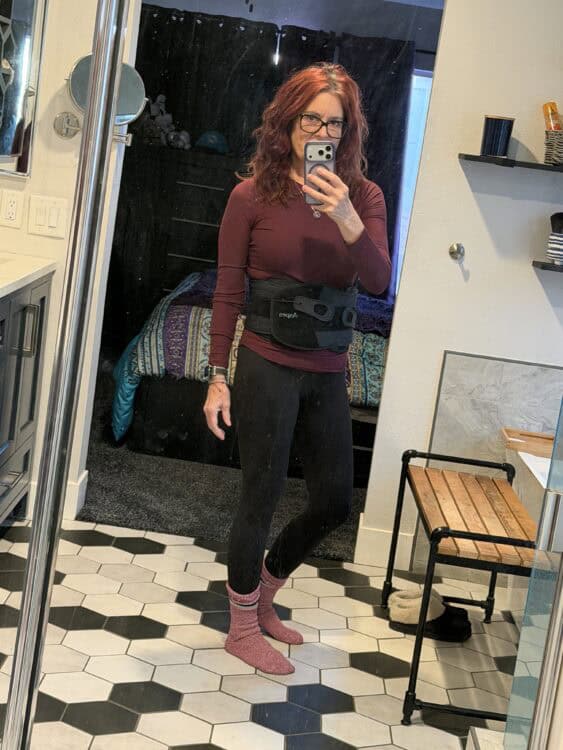
Going out socially was possible, but I had to wear shoes with no heels. I took only what could fit in my pockets or a tiny crossbody bag. I tired out fast.
My incision site healed really well, but I did develop a seroma immediately. that lasted probably around 12 weeks. It did get progressively smaller, but the first 3-4 weeks, it was very uncomfortable when I first laid down, so I had to lay down slowly. I also had to be careful if the brace rubbed it. (A seroma is basically a bump around/above your incision that is very swollen and has fluid in it. They vary in severity.)
Mine did not require draining, but some do, so speak to your doctor if you have concerns. I sent mine a photo through the patient portal. I had no infection or redness or fever, just a small ledge across my back that made it look like I could set something on this shelf and I hated to look at myself in the mirror. Doctors all suture differently, but mine were internal, and I had the surgical tape tabs on the outside. They started to peel off around eight weeks, but many come off sooner. Once they came off, the swelling went down faster.
Speaking of mirrors…ladies especially, give yourself grace. My body was entirely new post-surgery. My back was as flat as a board. It was like my booty had melted into my legs. I’m a size 2, I was 119 the day I had surgery, so as my husband says, I didn’t have much of a butt to begin with, but I still freaked out. WHERE IS MY BOTTOM EXACTLY? My lower abdomen had a pooch, and I just in general was saggy. Then that large bump across my back? I hated the huge sliding mirror doors next to my shower and tried to avoid looking.
I began to drive myself to PT but didn’t really do much else. I’m thankful for those that stopped by to see me and bring meals for us all, so the guys could have a break. You may feel like you can do things, but listen to your doctor. Don’t push yourself. I wanted to do more, but I was exhausted easily and not sleeping the best, so I chose to give myself a break and slow down. The first couple of social outings were GLORIOUS, however I had to choose my attire to work around the brace.
I did drink alcohol after a few weeks. (I had the okay.) I kept it to very small amounts. My tolerance was way down and I didn’t want to drink enough to forget no BLT. As far as intimacy, that was a while, for obvious reasons. Doctors may give you a timeline for that; I didn’t ask and waited until I felt like I could safely enjoy it. My hips had been a problem prior to surgery due to the nerves, and they were easily sore. We’ll just leave it at that.
In mid-April, we took our yearly trip to Costa Rica. It had been planned/paid for long before surgery was a thing, before my nerve pain even started. I wore my brace on the plane and in the car rides. I carried no luggage, and no shame here, but we used pre-boarding. This helped hubs get down the aisle carrying both carry-on backpacks and rolling both bags. (Airline staff just moved out of the way, they didn’t help, so don’t count on that.) It helped me toddle without being bumped or having to lean as someone around me reached for the overhead bin. I’ve never done it before but it was incredibly helpful.

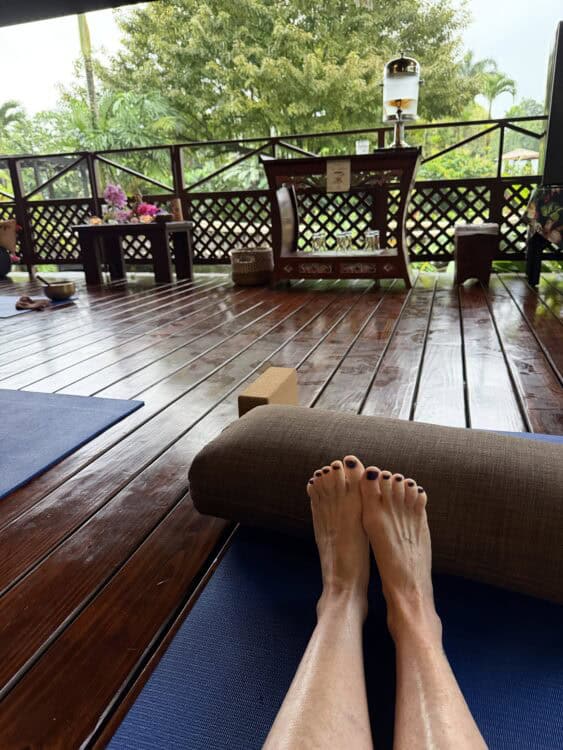


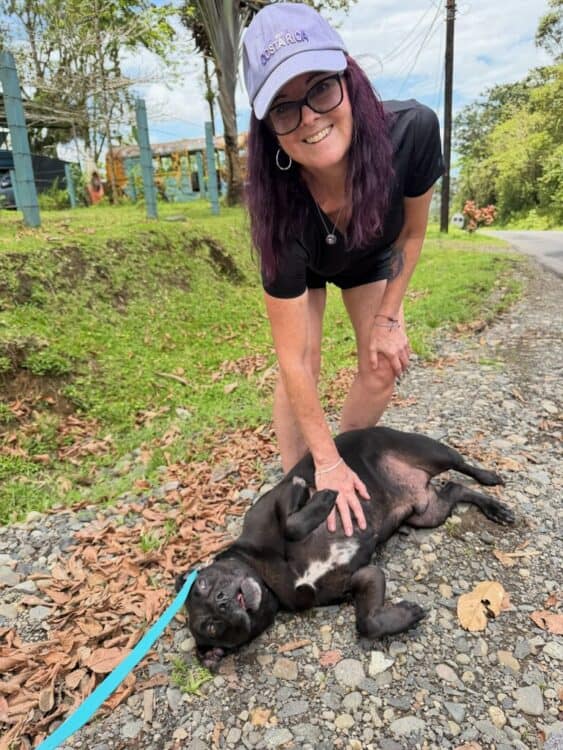

On the trip, I did nothing too active. We walked around the towns, walked on the beach, volunteered at a rescue dog organization, and spent hours on hours at either the swim-up bar or sitting in natural hot springs. It was the most therapeutic trip ever. I took my seat cushions, hubs ordered special blow up things to cushion our butts on the plane, and I alerted our drivers right away that I needed caution. (Private drivers are always so accommodating, and we’d used the same company for years.) I was sore, I felt the extra walking, but we went slow. If I hurt, we stopped. It was just what I needed.
What’s Long-Term Recovery after Back Surgery Like
Now, at five months, I am pretty much back to normal activity. No running, jumping, rebounding, etc., and of course, no skiing, horse back riding or anything that will have my bouncing for at least another six months. I’m back in yoga, doing mostly restorative but I do add some harder poses as I can. (I’ve actually enrolled in YTT, or yoga teacher certification!) Emptying the dishwasher with our very heavy plates is hard due to the twisting, and I don’t lift heavy things from the floor, but I listen to my body. I work normally, I drive, and I hike on terrain that’s as even as I can find.
I am a surgery success story. I’ve had a little nerve pain a couple of days, but x-rays show no movement of my vertebrae. I will continue to see a spinal surgeon as-needed, or once every 6-12 months for a while. I still have the OA so my back will never be perfect, but I can walk across the room. I can go to Disneyland. (Can’t ride big rides just yet! No coasters or any crazy movement for a while. Gotta work on core stability more first.) The debilitating nerve pain that prevented me from sitting, sleeping, walking, or doing anything normally is gone.
Recovery after back surgery is a process. It’s not immediate. You may not see an improvement every single day, but after each week, you’ll realize you could do something you couldn’t the week before. You’ll start forgetting about the surgery, and when someone brings it up, you’re like wow, that was forever ago…even if it wasn’t, because over time, you’ll realize you’re more normal than not. You may push too far and get a reminder with a sore muscle or twinge.
Your experience may be much easier; it may be harder. I’m pretty pain-tolerant, but my nerves had been so involved, rebuilding my energy and stamina took time. I was fine dealing with it mostly alone after the first, but I am so glad I didn’t have to. I’d also have been stinky….those showers are work.
Be kind to yourself. Spinal surgery is scary, but so is the idea of permanent nerve damage resulting in foot drop or inability to control your bathroom needs. If you feel your doctor isn’t helping, get another opinion. You only have one spine, and one life.
Speaking of another opinion — be careful about the rogue, uninformed, and unsolicited opinions of others. I had a friend who questioned my need for surgery. She was able-bodied, mostly healthy (though she’d regale you with stories of her ‘conditions’ if you asked) and she didn’t live with me, so she didn’t see my level of daily pain. When I mentioned my fear of having back surgery, she told me to not get ahead of myself, I was worrying for nothing, ‘I’m sure you’re not that bad to need surgery.’ It was incredibly condescending.
Thing is, I was that bad, and my MRIs were proof. When I confirmed the surgery was a go, she asked me if I felt it was truly necessary — and not in a supportive way. It was dismissive, as though I’d somehow been excited to hear my spine was being cut into. She then didn’t speak to me for days, and when she reemerged, she wouldn’t talk about the surgery and chose to dismiss it when it came up, to the point of forgetting when I was having it and then laughing when she threw out a date and got it so far wrong. If I had not done my research or had the support of a spouse or multiple doctors, it could have made me second guess my choice; her derision over me saying yes stuck in my head for a very long time. Some people just aren’t there for you when you need them, and surgery has a way of weeding them out.
Listen to your body. Do your research. Ask the questions. Research your doctor, too, and the hospital. And equally important: KNOW YOUR INSURANCE COVERAGE. Know where you’re at in the year, your deductible and how far into it you are. Ask your coinsurance costs, out-of-pocket annual limits, and be sure your providers and hospital/clinic are in-network. This will help you be prepared and avoid surprise $4300+ bills. (Look at the percentage of the agreed upon network amount, not just the total of the surgery.)
Understand what balance billing and the No Surprises Act are. If you need a brace, see if you can get it ahead of time on Amazon instead of overinflated insurance costs. My surgery was around $70,000 or so all-in-all, but that was an overnight stay and all in-network, and of course, I didn’t pay that…but an itemized bill will make you shake your head about the cost of something as inconsequential as Ibuprofen tablets. Do the work in advance.
You’ve got this! If you’ve got other questions, post them below!



The delay getting into PT seems like a reason to check appointment availability before surgery. Once the surgeon gives a likely start window, writing down the clinic’s availability and a backup contact could save some juggling later. Arranging a ride for those visits would help too, especially with the car trips you described.